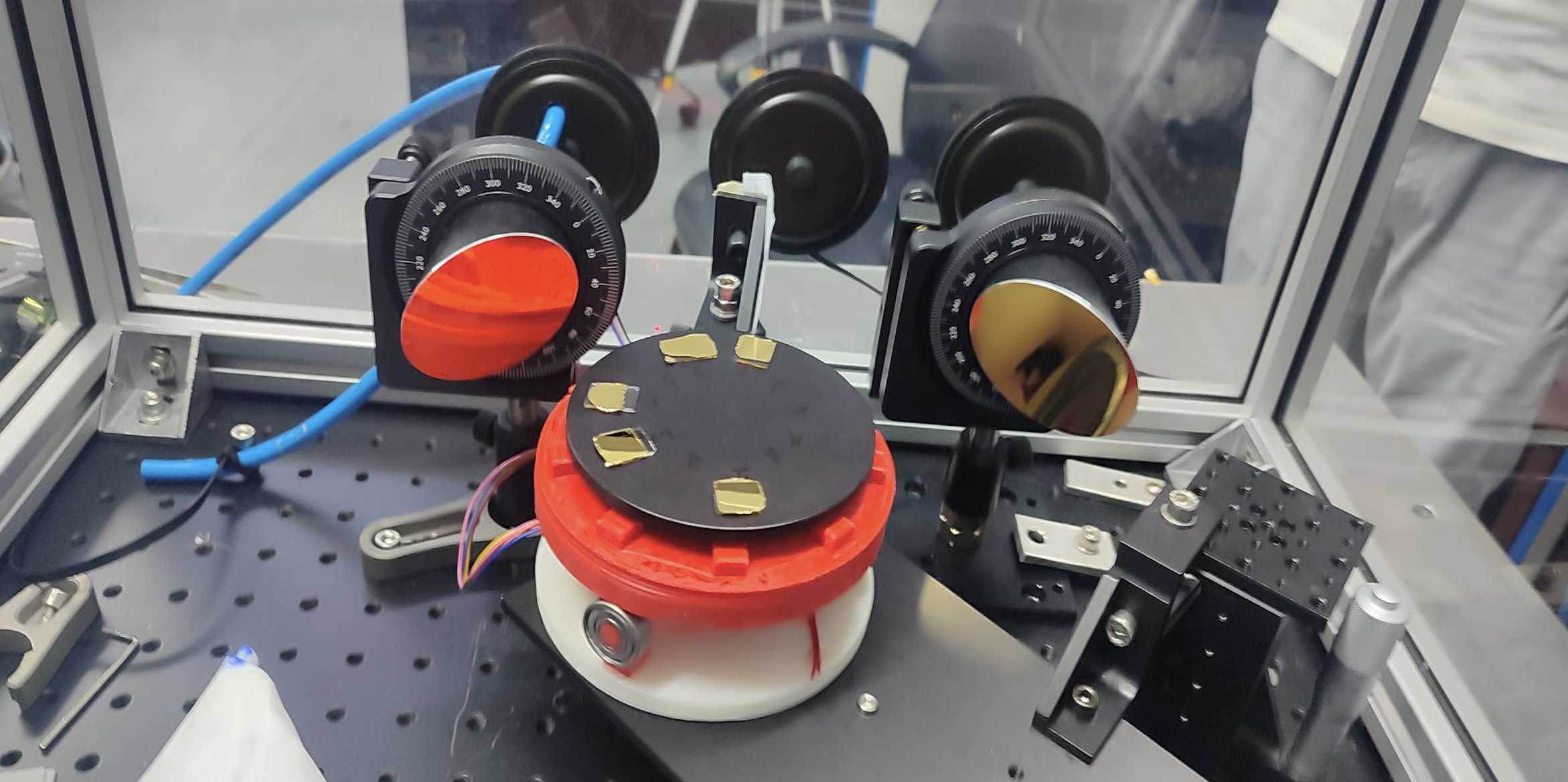

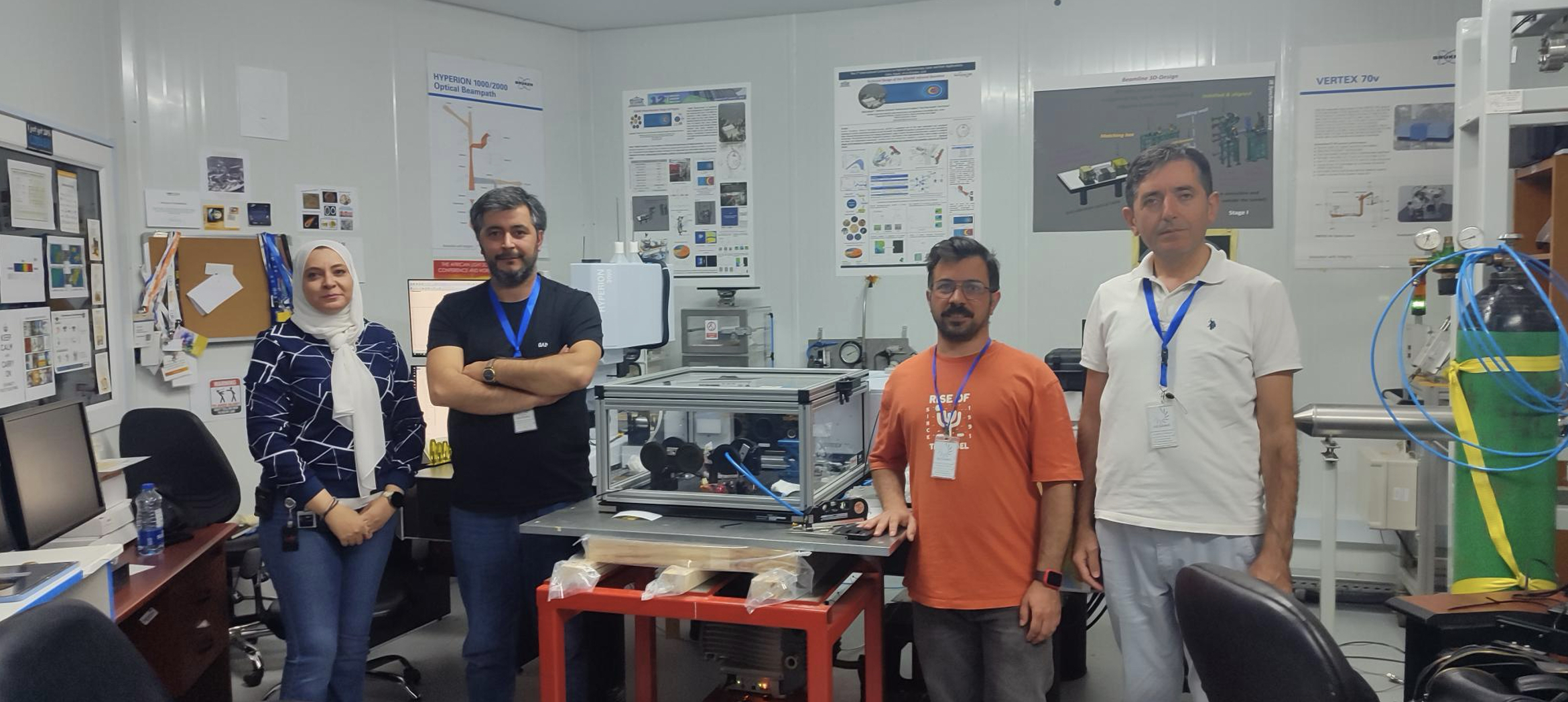
A team of researchers from the İzmir Institute of Technology and Selçuk University in Türkiye has used SESAME’s BM02-infrared (IR) beamline to investigate how carboranethiol molecules organise themselves into highly ordered monolayers on gold surfaces. Supported by the Turkish Energy, Nuclear and Mineral Research Agency (TENMAK), the study explores how molecular dipoles influence surface properties — a crucial step towards developing more stable and efficient materials for sensors and electronic devices.
Using a cutting-edge spectroscopy technique known as Reflection Absorption Infrared Spectroscopy (RAIRS), the team examined self-assembled monolayers (SAMs), ultra-thin films just one molecule thick that naturally form into well-defined patterns on surfaces.
The carboranethiol molecules studied possess a distinctive boron–carbon cage structure. Unlike most organic molecules, they can adjust their internal electric dipole without changing shape, making them ideal candidates for fine-tuning surface and electronic behaviour with molecular precision. “Our samples were self-assembled monolayers of carboranethiol molecules prepared on gold,” said Dr Adem Yavuz of the İzmir Institute of Technology. “These ultrathin organic films let us explore how molecular dipoles — tiny charge separations within a molecule — control film orientation and surface charge distribution.”
To uncover how these molecules bind and orient themselves, the researchers relied on RAIRS, a technique that detects the vibrational “fingerprints” of chemical bonds. By directing infrared light at a shallow angle and analysing the reflected signal, scientists can determine how molecules are positioned on a surface — a level of insight that standard microscopy cannot provide. “RAIRS is crucial because it provides molecular-level orientation information through the vibrational modes of B–H, C–H, and S–H bonds,” explained Dr Öztürk. “It is one of the few techniques that can directly show how molecules arrange themselves on a surface.”
Although the work focuses on fundamental molecular behaviour, the findings have broad implications for nanotechnology, biosensors, and corrosion-resistant coatings. The carboranethiol films demonstrated remarkable resilience, maintaining their structure under heat and chemical stress. “This stability makes them ideal candidates for use in devices that require durable, well-ordered molecular layers,” noted Dr. Necip Ayhan Tertemiz of Izmir Institute of Technology. “By understanding exactly how these molecules bind and orient, we can design better materials for electronic interfaces and sensing technologies.”
The researchers highlighted the value of SESAME’s collaborative environment in enabling their success. “SESAME offers an accessible platform for infrared experiments that require high-intensity, well-collimated light,” said Dr Yavuz. “The beamline scientist, Dr Kamel, was exceptionally supportive, helping us fine-tune every stage of our setup.”
Building on their results, the team plans to integrate RAIRS with complementary nanoscale characterisation techniques, including atomic force microscopy (AFM-IR), tip-enhanced Raman spectroscopy (TERS), and X-ray photoelectron spectroscopy (XPS). “We’ve shown that high-precision optical measurements can be performed and further developed by researchers in Türkiye,” said Dr Öztürk. “This is an important step towards building sustainable national expertise in surface science.”
With continued institutional support from TENMAK and SESAME, the researchers hope their work will inspire a new generation of scientists driving innovation in clean energy, molecular electronics, and nanotechnology across the region. “It’s not just about one experiment,” added Dr Tertemiz. “It’s about building the capacity to explore the molecular world with light — and doing it here, in our part of the world.”
The BM02-IR Beamline Principal Scientist, Dr Gihan Kamel, concluded that “There is a special excitement in seeing this new setup come to life for the first time at the IR beamline. It is very satisfying to witness this development mature and consolidate, and watching such a significant milestone is immensely rewarding.”